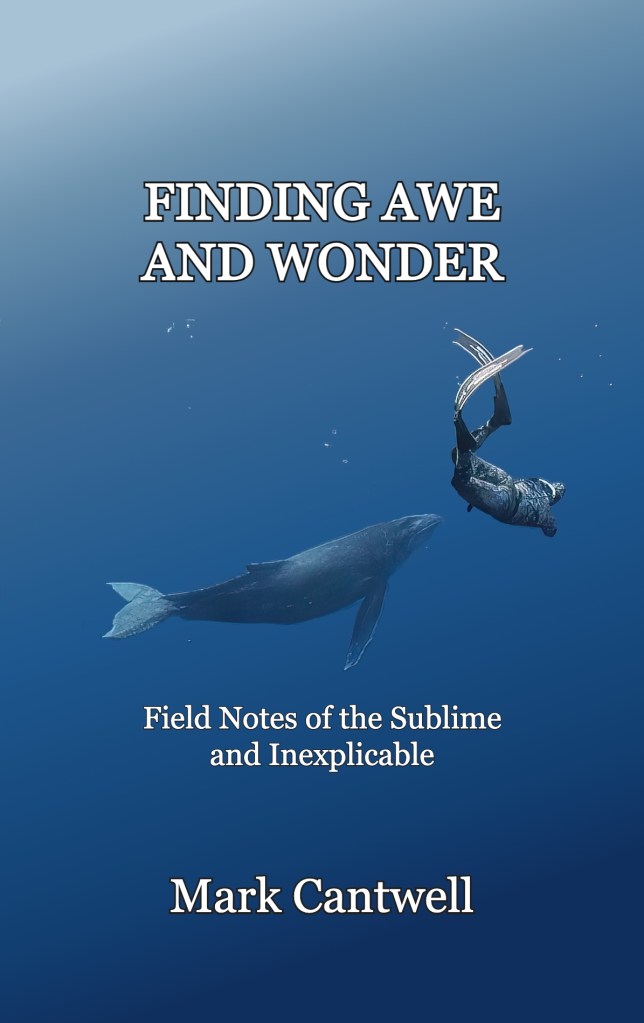
Preface to Finding Awe and Wonder
This memoir describes a variety of sudden and inexplicable moments I’ve experienced over the last sixty years that changed the course of my life. These moments range from feelings of awe and wonder I have had while viewing the night sky and ocean life, to literal dreams and premonitions that have miraculously come true, to witnessing shamanic magic in the villages and forests of SE Asia, to the ineffable feelings of love and affection for the people in my life. These moments span a multi-decadal arc and culminate in a series of events so extraordinarily improbable that I was compelled to change my mental model of how the world works and thus how I make life choices. They sparked a transition from living nearly completely in my head to engaging my heart and instincts, and ultimately led me to a much happier and more gratitude-filled life.
Friends and family have often told me they’ve been inspired by my stories, and have urged me for years to write an account so others might be similarly moved. But only now, as I enter my seventh decade, have I decided to share my experiences more broadly.
To give you an idea of the sorts of stories I’m about to reveal, consider a moment I had fifteen years ago when my boss called me into his office to offer me a promotion to Chief of Climate Services for the government of Canada. As we sat momentarily in silence looking at one another across his desk, I was startled by a clear and calm voice in the room:
“Fuck fear.”
My boss hadn’t spoken, and there was no one else in the office. Nor did it sound like my own internal voice expressing some random thought. Instead, the words seemed to be an actual noise vibrating my ears from the inside out.
In that instant, a memory was triggered of a visit I had made to Hawaii three years prior. I recalled standing on the lip of an 80-foot cliff, bound by verdant jungle on one side and pounding ocean surf on the other, all bathed in the molten light of sunset. The scene was so viscerally beautiful that I became enthralled and, for what may have lasted only ten minutes, entered a state of awe.
This memory arrived and disappeared instantly, and my attention jerked back to my boss who was waiting for me to jump up and accept the position. Obviously, I would accept—we both knew that any of our public service colleagues, handcuffed by their golden pensions, would have excitedly said yes.
And yet, my thoughts lingered on those two disembodied words.
In that moment—and everything happened in a single moment—I experienced a deep knowing, an absolute certainty that that fleeting feeling of awe I had experienced and forgotten had become a flashing beacon. It was a signal that I should leave my suburban home in Canada to live in a hut on the cliff I had seen years earlier between the sea and the jungle.
“Fuck fear.”
I inferred the words not so much as a dare, but as permission. From offer to decision took less than a blink. I politely declined the job, walked out of the office, immediately went home, and informed my wife of twenty years:
“We’re going to sell everything we own, pull the kids out of school, and homeschool them in a hut in the jungle on the edge of the sea cliffs of Hawaii. You can come if you want.”
In spite of her being a ferociously protective Corsican mother, genetically trip-wired for vendetta, she did not murder me. Instead, she just looked at her unhinged husband, saw in my eyes that I was serious, tilted her head in the way saints do, and gently said: “OK.”
What appeared to be the delusional fiat of a man in a full-blown midlife crisis became the start of a brave experiment and the best decision I ever made. It was a semi-controlled burn of an old identity. That moment catalyzed a change in the way I make choices and was the beginning of a transition from head to heart.
That instant, that rupture, became the seed of this book.
I want to share some of the more inexplicable and improbable moments of my life – those that primed me to take that decisive risk on that day and move to the jungle. More to the point, I want to explain why I now seek out and harness feelings of awe—that primordial rapture— as a compass for making life decisions. I hope that if I’m able to articulate my stories in the right way, perhaps you will be sufficiently inspired to fuck fear and begin your own transition from head to heart.
But Caveat emptor: this isn’t an adventure travelogue. While I have peppered the book with occasional exotic shenanigans, I only do so to either give context or convey a bit about my character to make clear why I did what I did. This isn’t a pot boiler novel either. There are no adrenaline-fueled exposés about war, violence, or political intrigue. No courtroom dramas. Nothing about celebrities, recreational drug use, or amoral wealth. I do not discuss religion or proselytize.
Most importantly, this is not a self-help book. Instead, think of my stories as a collection of field notes—signposts for anyone interested in exploring alternative ways of seeing and moving through the world.
Having said that, there are a few cohorts who may find my stories particularly compelling. The first are men approaching or transitioning through that existential phase commonly known as a midlife crisis. Their partners too, may gain some insight into why their husbands appear to have gone bananas.
Another group are Gen Zs and Alphas – those who have barely begun their lives. These are the most digitally hyper-connected generations in history, making them relatively bereft of real-world interactions and thus susceptible to mistaking connection for communion. I trust my stories will excite them, but I also hope that they are inspired to seek out real-world experiences they don’t yet realize even exist.
So, what do I mean by the term awe, anyway? This isn’t a trivial question.
While there are many references to awe throughout history in religion, sociology, psychology, and philosophy, scientific research on the subject is inchoate; the first research papers were published only about twenty years ago. The field is so relatively new that even a formal definition of awe based on objective analysis hasn’t quite been nailed down yet.
Nevertheless, one definition that seems to have gained acceptance among psychologists is:
“Awe is a brief emotion that people feel when encountering something vast, and that elicits a need for accommodation which is sometimes accompanied by a sense of fear.”
The key characteristics of awe—the ingredients needed to feel it—are that it encompasses a sense of enormity (of space, time, or power) and that it elicits a need to understand an experience that defies one’s model of how the world functions.
The term wonder, on the other hand, is the state of open-minded fascination and curiosity that elicits a desire to explore or understand a given event or phenomenon.
Based on my own subjective internal experiences, I believe the definition of awe above – derived from objective external observations – may be incomplete. Maybe even flawed. But it will suffice until I reveal my stories, after which I will explain my perspective and perhaps even make suggestions for further scientific research.
Many memoirs have been written about mystical experiences, the power of love, the impact of nature on the human psyche, or of spiritual crisis in midlife. But I’ve never read one that focuses on the role that awe played in the life of the author quite the way I experienced it. I therefore have neither role model to emulate nor preconceived notion for how best to go about getting my stories out of my head and into yours.
As a result, I’ve decided to just write down what I remember as accurately, honestly, and openly as I can without the usual attempts at flowery or evocative language that I find to be an irritating affectation of so many memoirs. I’m a technical, non-fiction writer by training, so I’ll stick to what I know.
Another reason why I decided to write this book now relates to my sense of impending global doom. Or at least, impending global darn. I’m old enough to have witnessed first hand the declining trends in global economic, political, environmental, and social systems, and I have a professional understanding of the terrible consequences heading our way. It’s therefore painfully obvious that there is an urgent need for people to collectively think and act differently if humanity is to remain viable and healthy. This is what I hope my stories promote: an alternative way of moving through and managing the world.
Yet another reason for offering my stories now relates to recent technological advancements. It’s easy to understand why there has been such an explosion in scientific advancements over the last few decades in all fields when you consider that nine out of ten scientists who have ever lived are alive today. But Artificial Intelligence seems unique in the history of science and technology due to its ubiquitous nature: it is capable of perpetuating innovation in virtually any field of study, including itself. While this offers enormous potential for good, AI is also a double-edged sword that has already done a massive disservice to the world by dissolving the glue that binds people and societies together: trust.
It is now commonly accepted that we can no longer trust as true or real what we see, hear, or read online—which is where much of modern life is now spent. This has led to social chaos. The internet is now undergoing what seems to be a terminal case of AI distrust disease and is well on the way to deteriorating from a gleaming spaceport of infinite potential to a dodgy and poorly lit bus stop.
The science fiction author Arthur C. Clarke predicted the impact of superintelligence fifty years ago. He raised the concern that humans will not know what to do with their time once computers displace them from their daily work. He proposed that when the masses become bereft of meaningful activities, they will need an answer to existential questions like, “What is the purpose of my life?” or “What do I want to live for?” Since I don’t believe machines are a repository for the intangible values humanity needs to survive and thrive, I hope my stories at least showcase something meaningful that is beyond the ken of any widget to feel, appreciate, or offer insight.
This book is an attempt to defend the unquantifiable in a digital world.
Part 1 describes some of my more exotic experiences – from a modern Western point of view – such as witnessing shamanic magic in the cities and jungles of Indonesia, as well as bizarre incidents when unlikely premonitions and dreams came true. This part of the book then segues to the more easily relatable but profound feelings of love and affection.
Part 2 focuses on a period of my life when I had drifted into existential crisis and details the gloriously stupid and unsuccessful ways that I tried to save myself, such as ultramarathoning up mountains, weeks long mind-numbing competitive meditation sessions, and horror-filled ayahuasca ceremonies. It also describes how encounters with awe and wonder propelled me out of the quagmire that was my life at the time, and why I now seek out those feelings.
Fortunately, anybody can access feelings of awe and wonder: if I can, anyone can. I’m just an ordinary fellow with the extraordinary luck of being alive in a land of opportunity, grateful just to have been born. In fact, the odds that any of us exist at all are so astronomically small, and the mysteries of the universe so mind-boggling infinite, that it’s an enigma to me why awe and wonder aren’t baseline states of every living creature.
 Finding Awe and Wonder